
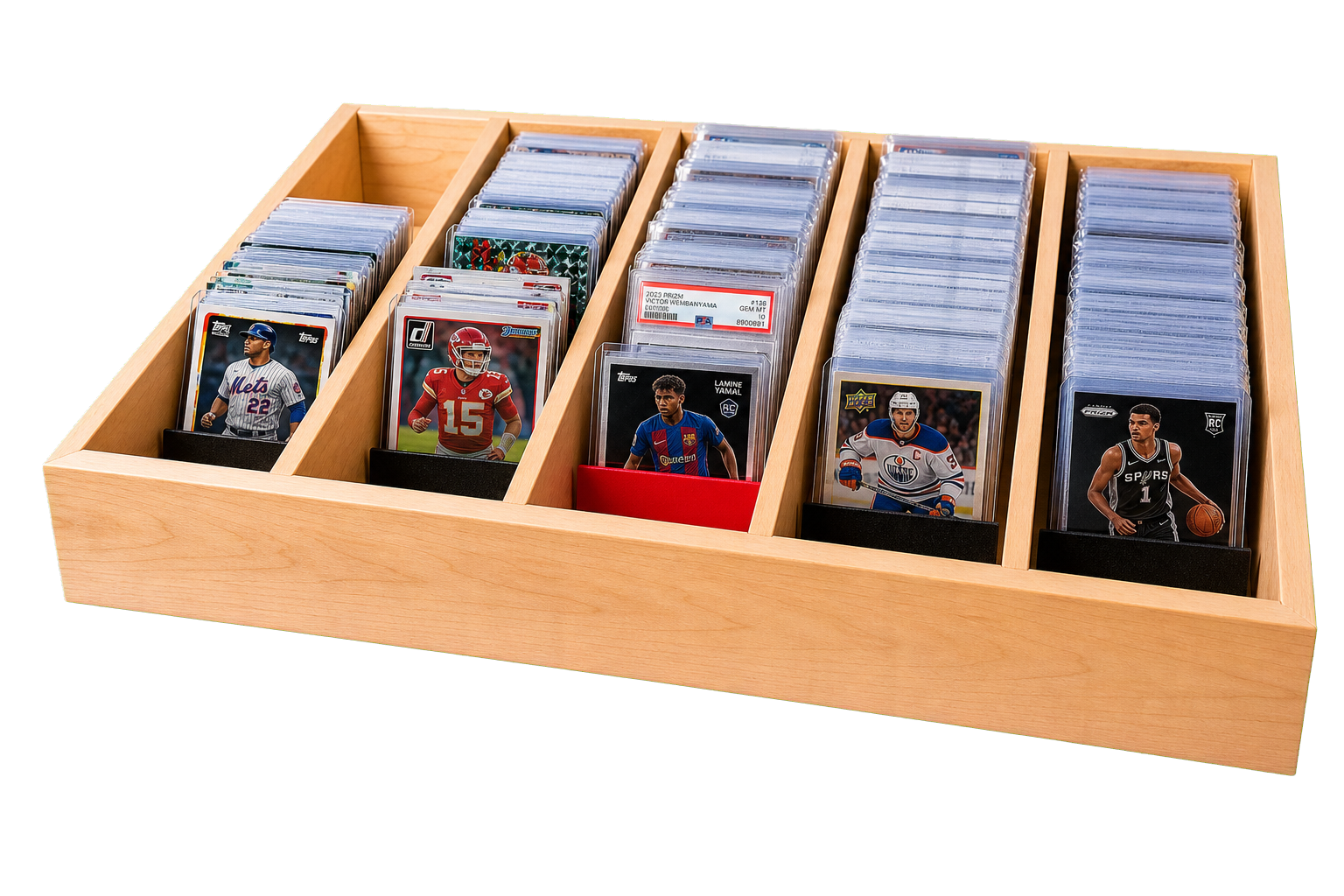
How Many Cards Can You Actually Store? Slab vs. Top-Loader Capacity Planning
One of the most common mistakes collectors make is buying storage for the collection they have today, not the one they'll have in two years. The second mistake is assuming graded slabs and sleeved raw cards take up the same room. They don't — not even close — and planning around that difference is how you avoid buying storage twice.
Why is slab capacity so different from raw-card capacity?
Because a graded slab is several times thicker than a sleeved card. A raw card in a penny sleeve and top loader is thin; a graded holder is rigid, deep, and — depending on the grader — chunky. Remember that slab sizes aren't standardized: PSA holders are relatively slim, BGS slabs are noticeably thicker and deeper, and CGC and CSG offer extra-thick holders for patch and relic cards. So "how many fit" depends heavily on what you're storing. A drawer that swallows thousands of top loaders will hold a fraction of that number in BGS slabs.
How do you estimate how many cards will fit?
Think in thickness: total drawer length divided by the thickness of one protected card. Stand your cards upright like files and the math is just how many card-widths of depth you have. Sleeved top loaders are thin, so they pack tightly; slabs are thicker, so the same drawer holds fewer. The practical takeaway is to estimate separately — one number for your raw/top-loaded cards, a different (smaller) number for your slabs — rather than using a single figure for everything. If you store across multiple graders, plan around your thickest holders so you're never short.
How many cards does a cabinet actually hold?
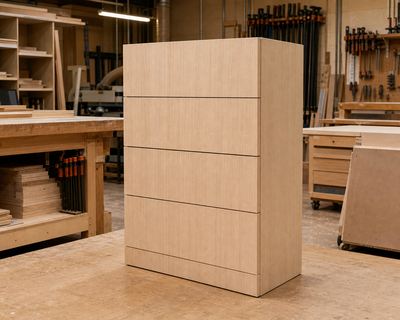
A purpose-built cabinet holds far more than improvised storage — on standard Apex Archive models, 3,400+ PSA slabs or 11,200+ top loaders, with capacity varying by size and configuration. The reason a cabinet outperforms a pile of boxes isn't magic; it's that every cubic inch is usable when cards stand upright in properly spaced dividers, instead of being lost to dead space and stacking. Adjustable dividers let you tune each drawer to the exact thickness of what's inside it, which is what makes those numbers achievable in practice.
How should you plan for a growing collection?
Size up, and choose adjustable over fixed. Collections grow in bursts — a good break, a new set, an estate buy — and re-housing a collection is tedious and risky. Buying a little more capacity than you need today, with dividers you can re-space as the mix of slabs and raw cards shifts, means your storage adapts instead of forcing you to start over. It's the difference between a one-time purchase and a recurring headache.
For more on protecting what goes inside, see our guides on storing graded cards and protecting raw cards. And when you want to size a cabinet to your exact collection — slabs, raw cards, or a mix — you can configure one to fit, dialing in drawer count and divider layout around what you actually own.
More guides
Build a home for your collection.