
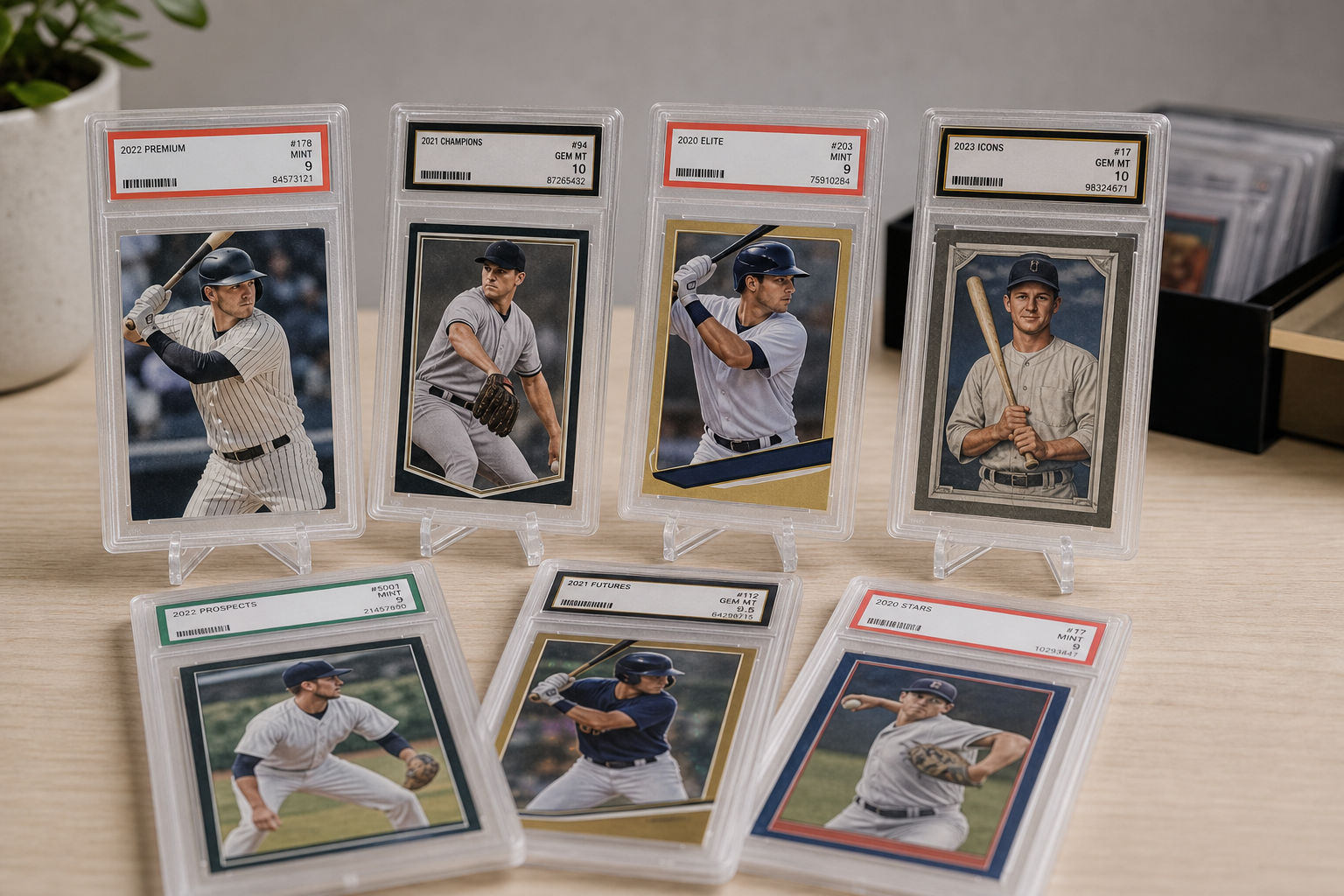
How to Store Graded Cards (PSA, BGS & CGC Slabs) the Right Way
Your graded cards are the cornerstone of your collection — authenticated, encapsulated, and, in many cases, irreplaceable. It's tempting to think the slab does all the work. It doesn't. The hard plastic holder protects the card from physical contact and air, but how and where you store that slab still decides whether your grade — and your investment — holds up over the years.
This guide covers how to store PSA, BGS, and CGC slabs properly: orientation, materials, environment, and how to scale as your collection grows.
Do graded slabs really need special storage?
Yes. Encapsulation protects the card itself, but the slab is still vulnerable to the things that quietly destroy collections: heat, swings in humidity, UV light, pressure, and dust working into the case seams. A 10 that bakes in a hot attic or sits in a damp basement can develop a warped holder, clouded plastic, or internal condensation — and a damaged holder raises questions about the card inside it.
Storing slabs well isn't about being precious. It's about not undoing the grade you paid for.
Should you store slabs upright or stacked flat?
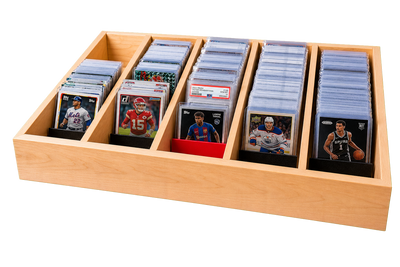
Store them upright, like books on a shelf — not stacked in tall piles. Stacking puts uneven weight on the holders at the bottom, can stress the case seams over time, and turns finding one card into unloading the whole pile. Standing slabs vertically in a divided drawer keeps each holder fully supported, lets air move around it, and makes any single card instantly reachable.
Upright storage also protects the slab's edges and corners from the rubbing and shifting that happens every time you dig through a flat stack.
What materials are safe for storing graded cards?
Stick to archival-safe, acid-free, PVC-free materials — and avoid anything that off-gasses. Cheap plastics that contain PVC can release plasticizers over time that cloud holders and damage surfaces. For long-term storage, look for inert, acid-free materials and solid, stable structures that won't shed or react with your slabs.
One detail many collectors miss: slab sizes are not standardized. All grading companies hold the same 2.5″ × 3.5″ card, but the holders differ. PSA slabs are relatively slim, BGS slabs are noticeably thicker and deeper, and CGC and CSG offer multiple thick-holder options for patch and relic cards. If you store across grading companies, your storage needs to accommodate the thickest holders you own, not just the standard ones — which is exactly why adjustable dividers beat fixed slots.
What temperature and humidity should graded cards be kept at?
Aim for 40–55% relative humidity and a stable 65–75°F (18–24°C). That range isn't arbitrary — it mirrors the conditions museums use to preserve paper. Above roughly 60% humidity, you risk warping, foil curling, and even mold; below about 30%, cards and holders can grow brittle.
Just as important as the numbers is consistency. Wild swings between hot and cold, humid and dry, are harder on a collection than a steady, slightly-imperfect environment. That's why attics, basements, and garages are the worst places to keep cards, and an interior, climate-stable room is the best. We go deep on this in our guide to humidity, light, and temperature.
How many slabs can you realistically store?
More than you'd think — if your storage is built for upright slabs rather than improvised. Because graded holders are thicker than raw cards, slab capacity comes down to drawer depth and how efficiently the dividers are spaced. A purpose-built cabinet drawer can hold thousands of slabs while keeping every one upright and accessible.
If you're trying to plan capacity for a growing collection, our capacity planning guide breaks down slab versus top-loader math by drawer and cabinet size.
Where should you actually keep them?
Pulling it together, the ideal home for a graded collection is: upright, in adjustable dividers, made from stable materials, kept in a climate-consistent interior room, away from direct light. Loose boxes and random shelves check none of those boxes; a cabinet built for the job checks all of them.
That's exactly what we build. Every Apex Archive cabinet uses adjustable dividers that flex to fit PSA, BGS, or CGC holders, soft-close drawers that protect your slabs every time they move, and furniture-grade construction designed to live in the room where you actually keep your collection. When you're ready, you can design your own cabinet around the collection you're protecting.
More guides
Build a home for your collection.